Saturday, April 23, 2016

Week 4 -- Medicine + Technology + Art

MRI Scan
Everything we have learned about the human body has stemmed from the relationship between medicine and art. Although an unlikely pair, art has fueled the findings of scientists and the ability to understand the interworking networks that comprise the human body. Andreas Vesalius, author of De Humani Corporis Fabrica, is considered the founder of human anatomy and was the first to accurately reflect the anatomy of the human body. This artistic triumph also translated in success in medical fields when the treatment of a disease was finally joined with accurate bodily locations (Vesna). Now, we have advanced devices such as the MRI, which on the surface, seems to be a tool of medical detection. Casini takes this idea and identifies the art behind the MRI, showing how it is considered a self-portrait, as we try to identify the parts of our brain that make up our ‘personhood’ (Casini).
Kim Kardashian Face Before and After Plastic Surgery. I don't know what she did but she sure looks different!:
Before and After Plastic Surgery
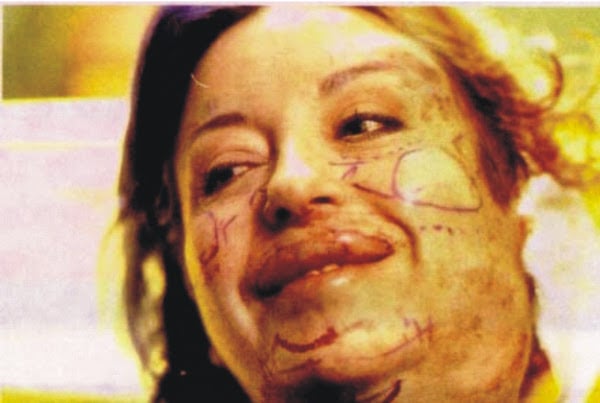
Orlan during The Reincarnation of Saint Orlan (1990).Photo: via Required Taste.
Orlan during The Reincarnation of Saint Orlan
In my daily life, I see this dynamic of art and medicine in the common occurrence of plastic surgery; there were 15.6 million plastic surgeries in the U.S. in the year 2014 (Plastic). It is commonly publicized with celebrity figures such as the Kardashians. Discussing this idea in the context of cosmetics, this type of plastic surgery is aimed at finding beauty and consequently, this form of medicine, now leaning more toward art. Beauty is defined as, “ A combination of qualities, such as shape, color, or form, that pleases the aesthetic senses, especially the sight” (Definition). Women, each time they apply makeup or style their hair do so in hopes of attaining this idea of beauty. Plastic surgery takes this idea beyond the ability to apply and remove, and makes it a permanent occurrence. Take Orlan, the French artist who made her body a work of art. She underwent nine surgeries to attain, what she believed to be, the aspects of beauty from iconic paintings. In an interview she says, “If you were to describe me without anyone being able to see me, they would think I am a monster, that I am not fuckable. But if they see me, that could perhaps change” (Jeffries). This portrays women’s perception of art and beauty and how at this crossroads of science and art, this type of reformation is possible and widely done. This fusion of art and science is at the forefront of body-altering ability.


References
Casini, Silvia. Magnetic Resonance Imaging (MRI) as Mirror and Portrait: MRI Configurations  sssssbetween Science and the Arts. Ca’ Foscari Università di Venezia. 23 April 2016)

"Definition of Beauty in English:." Beauty: Definition of Beauty in Oxford Dictionary (American sssssEnglish) (US). N.p., n.d. Web. 23 Apr. 2016.

Jeffries, Stuart. "Orlan's Art of Sex and Surgery." The Guardian. Guardian News and Media, sssss2009. Web. 23 Apr. 2016.

"Plastic Surgery Procedural Statistics." American Society of Plastic Surgeons. Web. 23 Apr.   sssss2016.

Vesna, Victoria. Medicine Body Lecture. Video. 23 April 2016.


Tuesday, April 12, 2016

Week 3 -- Robotics + Art

Robots in Movies (Transformers)
     Contrary to popular belief, the relationship between robotics and art is mutual: both counterparts further the advancements of the other. As Vesna said in this week’s lecture, the idea of the robot stemmed from the arts (specifically theater and then movies). We have used art to inspire our robotic advancements and in return, have used robots to bring art to a new, supernatural realm. For instance, the movie Transformers follows the plot of supernatural robot cars – autobots and decepticons who have sought refuge on earth (Plot). This idea of robots in art (and this case movies) makes us question our existence as humans and where we stand with the developing technologies – will they ultimately have the power to overtake us?
Image result for lacma
LACMA participates in "Open Content Program" (Jordan)
With these technological advancements and ability to mass reproduce, many critics have argued that we have lost an aspect of originality and tradition in our works. Walter Benjamin made the claim that art is no longer unique and authentic. He believes the era of mass production has stripped away the meaning behind a piece – especially photography (Vesna). However, I believe Benjamin failed to acknowledge the benefits. For example, new programs have been put into place such as the “Open Content Program” that makes digital art free to the public in hopes to foster artistic awareness, appreciation, and accessibility (Open). This universality is special because it allows for greater discussion, analysis, and study of art and rather breeds a new perspective and authenticity. Places like The Getty, National Gallery of Art, Rijksmuseum, Walters Art Museum, Yale University and LACMA have adopted the “Open Content Program” for this purpose (Kuan). Art is something to be shared among all people; it is a uniform language that unifies all and is ultimately beneficial to be widely shared.
Image result for self driving car
Autonomous Car (Extreme)
Although industrialization and robotics on the surface seem to take away from the originality and humanity behind art, it is rather an accurate portrayal of our times. Paint and paper are no longer the only means to express ourselves – rather it can be done in multiple ways – some of which are also furthering society. Take the idea of an autonomous car, where Britain is the world leader in adopting this form of transportation (Britain). The design of the robot car and every aspect of its shape and look is grounded in art. In this age, robotics is ubiquitous, however, as is art.


References
"Britain Leads the World in Putting Driverless Vehicles on the Roads." The Telegraph. Telegraph      kkkkMedia Group. Web. 13 Apr. 2016.
Extreme Tech. It's 2015, Self Driving Cars are More Than Just a Promise. Web. 13 Apr. 2016.
Jordan, Chris. Urban Lights. 2008. LACMA. Metro. Web. 12 Apr. 2016.
Kuan, Christine. “Artsy, Technology, and the Power of Public Access”. Princeton University. 26      jjjjjJune 2014.
"Open Content Program | About the Getty." The Getty. Web. 13 Apr. 2016.
"Plot Summary Transformers." IMDb. IMDb.com. Web. 13 Apr. 2016.
Tansformers. Black Film Reads.Web. 13 Apr. 2016.
Vesna, Victoria. “CoLE.” CoLE. Web. 13 Apr. 2016.

Friday, April 8, 2016

Week 2 -- Math and Art

     Growing up in a time of expanding technology, the fusion of math and art are difficult to miss. Math, including its contributions to the computer, have helped enhance art and its refinement. For example, new applications such as Adobe Photoshop have been used to manipulate images yet still create original paintings (The Relationship). Computers have been able to spread this medium to a larger population and encourage the growth and appreciation of art; however, even the most basic forms of mathematics are included in the images themselves.
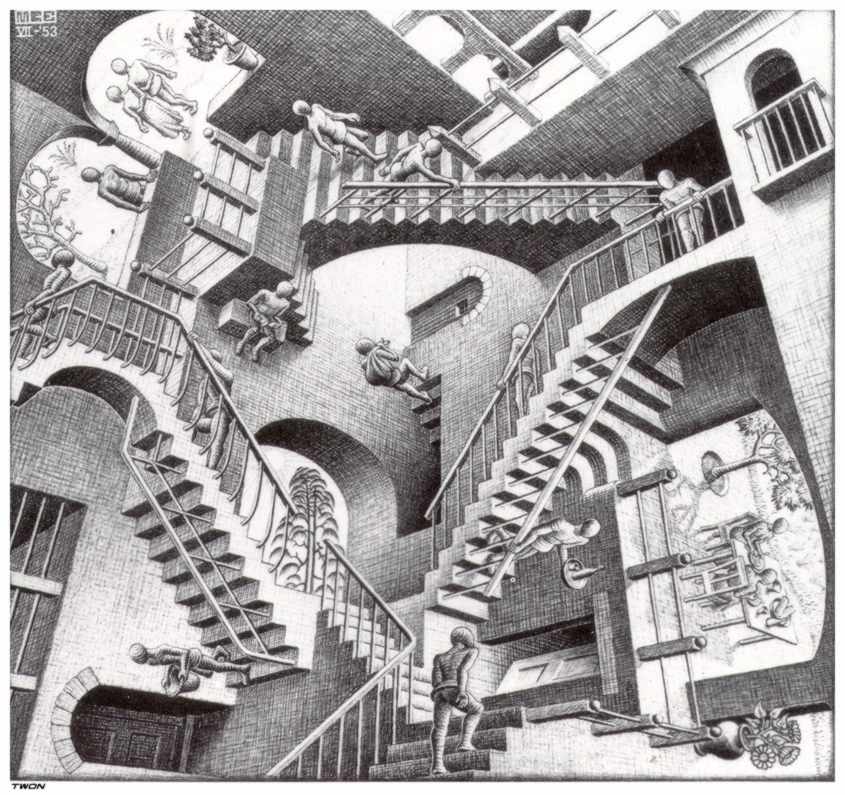
Image Relativity
Image result for the mona lisa
Golden Ratio
This week, Dr. Vesna discussed how art incorporates perspective, numbers and ratios (such as the Fibonacci sequence and Golden Ratio) to create more realistic works. Artists such as Brunelleschi and Alberti were pivotal in introducing the ideas of perspective and optic triangles that help portray the natural depth seen in the world and transfer it to paper. Da Vinci used the idea of the Golden Ratio to create the Mona Lisa, where these proportions of body, to head, to picture have created one of the most iconic pieces of art (Vesna). My favorite artist, M.C. Escher uses math to divide the planes and play with impossible spaces, creating the image, Relativity with the optical allusion of ascending and descending stairs (The Mathematics). Although the naked eye does not focus on the math behind this piece, it is what allows for this allusion, it is omnipotent in all aspects of art.
heel strike 701737 The Simple Math Behind Running Faster
Angle at which heel touches the ground 
            Even as a runner, I see art; it is present in depicting my speed. Depending on the mathematical angle and amount of force on my heel, my speed levels vary (The Simple). Math can even be seen in the way in which we perceive art; in an article released by the National Institute of Health, claims have been made saying, “Eyes may use math to detect motion”(Eye).
This is such an interesting concept that I loved learning about this week. I firmly believe that math is infused in all aspects of life, and rather than having a juxtaposition between math and art, a fusion is naturally induced.


References
"Eye Cells May Use Math to Detect Motion | National Institutes of Health (NIH)." U.S National Library of Medicine. U.S. National Library of Medicine. Web. 08 Apr. 2016.
"The Mathematics of Art - Math Central." The Mathematics of Art - Math Central. Web. 08 Apr. 2016.
"The Relationship Between Art and Technology." Web. 08 Apr. 2016.
"The Simple Math Behind Running Faster - Strength and Conditioning Training for Sports." Strength and Conditioning Training for Sports. 2009. Web. 08 Apr. 2016.
Vesna, Victoria. “Mathematics.” Lecture. CoLE DESMA 9. Web.

Saturday, April 2, 2016

Week 1 -- Two Cultures

My two cultures
fdfdffThe Lebanese Civil War of 1975 took the lives of 131,104 people and drove my parents out of their homeland (Lebanese). It introduced them to the safety and opportunity of the United States. Here, they began a family, with the expectation that their rich Lebanese culture would still be a pivotal aspect of the lives of their five children. However, being raised in the United States, I have always felt the pull between both cultures – where do I belong? Which culture represents myself and my values? Do I need to choose?
Schools breeding conformity
This idea of contrasting cultures also translates into my college experience. UCLA is geographically split on the lines of humanities and sciences – North campus and South campus. As explained in Changing Education Paradigms, our outdated education system fosters this division through the separation and batching of curriculum and students. It merely breeds standardization and conformity (RSA). I feel this idea in the colloquial language used at UCLA when I say, “I’m a South campus major.” This blanket statement completely discredits the other interests that I have in the arts.
jobs-3
The future
 CP Snow, in his work, “The Two Cultures and the Scientific Revolution” believes this separation of cultures prevents us from reaching our full capability for creativity (Snow), and I believe he speaks the truth. The ability to fuse these two cultures has bred the most advanced thinking. For example, 3-D printing, the integration of art and science, is now considered by the Huffington Post to “enable a new kind of future” used for life-saving purposes (Mellgard).
This Third Culture has had differing perspectives. John Brockman expanded on the idea of the Third Culture, believing it to be a relationship between contemporary scientists and the public (John).  This leads me to question where society is now and whether we have truly reached an inclusive Third Culture. However, I feel like I can make gestures in my life, such as taking this course, to bridge the two cultures together in my life, and hopefully inspire those around me to do the same.


References:
"John Brockman: Matchmaking with Science and Art (Wired UK)." Wired UK. Web. 01 Apr. 2016.
"Lebanese Civil War - the Polynational War Memorial." Lebanese Civil War - the Polynational War Memorial. Web. 01 Apr. 2016.
Mellgard, Peter. "Medical 3-D Printing Will 'Enable a New Kind of Future'" The Huffington Post. TheHuffingtonPost.com. Web. 01 Apr. 2016.
Snow, C. P. “Two Cultures and the Scientific Revolution.” Reading. 1959. New York:        hhhhhCambridge UP, 1961. Print.
"RSA ANIMATE: Changing Education Paradigms." YouTube. YouTube, 2010. Web. 01 Apr. 2016.