 |
| Third Ear |
The field of
Biotechnology and Art faces a lot of criticism regarding ethics and genetic
manipulation. As Ellen Levy ultimately highlights in her article, it is
difficult to define life, and these classifications will bring about debates
regarding legal rights, intellectual property, politics, and society as a whole.
As we begin to blur what is human, transgenic, and cyborg there will ultimately
be no status quo (Levy). This raises the question, “To what extent will we push
human capability?” In this week’s lecture, Professor Vesna discussed Stelarc
and how he wanted to use biotechnology to overcome human limitations. He
experimented with human implants – by inserting a third ear in his arm. He
claimed without further advancements, human body would become obsolete (Vesna).
This idea is frightening to think about – with
all the genetic engineering around us, where do we draw the line? If the
modification proves no purpose for human betterment and is merely used as an
artistic medium, should it be an allowed practice? Artists began to believe
that labs were equivalent to their studios and freely experimented from
creating robotic drawing arms to skin cultivated coats. Steve Kurtz founder of
the Critical Art Ensemble, allegedly took this idea to far and questionably
ended up killing his wife in the name of biotechnological experimentation. He
was tried in court however, and was deemed not guilty (Steve).
 |
| Genetically Modified Food |
This week’s
lecture mostly discussed genetic injections in the lab, however society is very
oblivious to the omnipotent biotechnology in our daily lives. 60% of the
processed food on supermarket shelves contain some genetically modified
ingredient (Altered). The FDA allows the use of steroid-hormone implants in our
household meats (Producing).
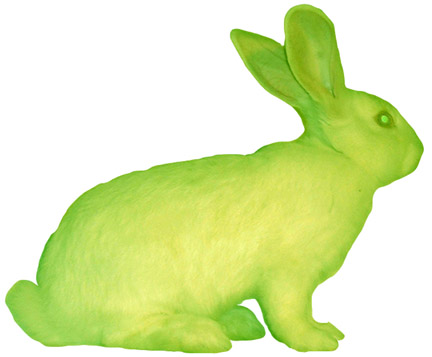 |
| Fluorescent (GFP) Bunny |
Biotechnology
has infiltrated every aspect of life, however most notably, the medical. Take
the fluorescent bunny – it served not only as an artistic medium but is useful
in tracking active cancer treatments. Biotechnology and art, although
controversial, is developing at a rapid pace and is a promising medium for both
artistic and biological furtherment.
References
Levy, Ellen K. Defining Life: Artists Challenge
Conventional Classifications. Web. 05 May ssssss2016.
"Altered Food, GMOs,
Genetically Modified Food - National Geographic." National ssssssGeographic.
N.p., n.d. Web. 05 May 2016.
"Steve Kurtz." Wikipedia.
Wikimedia Foundation, n.d. Web. 05 May 2016.
"U.S. Food and Drug
Administration." Steroid Hormone Implants Used for Growth in Food-ssssssProducing Animals.
N.p., n.d. Web. 05 May 2016.
Vesna, Victoria. Lecture
Biotechnology and Art. Web. 05 May 2016.

I really enjoyed your observations and analysis this week on biotechnology and art. I agree that it is scary how thin the line is between what is considered "too far" or not. This really made me think. As I talked about in my blog post this week, I think i get most frightened when technology appears in so called "natural" places such as food, plants, trees, which I guess is where I think the line is.
ReplyDelete